
What it does#
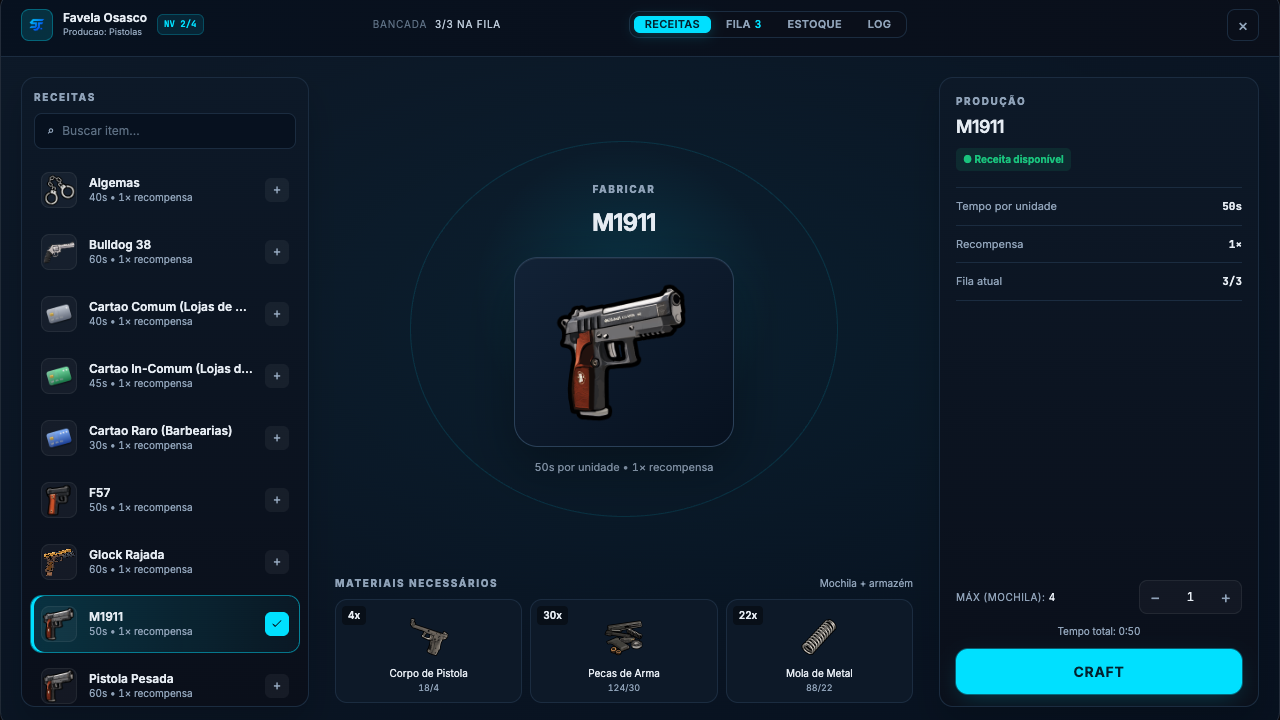
A complete production chain: the player gathers materials, crafts at the bench, stores the output and resells it — or orders from whoever produces.
None of it is configured in a file. Benches, recipes, routes and upgrades are
created in game, through /craftconfig, and take effect immediately for anyone
already online. You never edit .lua and never restart the resource.
Benches and production#
- As many locations per bench as you want, marked by walking to them.
- A queue that keeps running while the player is offline: crafting counts in absolute time, and whatever finished waits at the bench.
- Configurable simultaneous production; output goes to the warehouse or the backpack, as the recipe allows.
- Per-recipe permission, so a recipe can belong to one group inside a bench that everyone else also uses.
- Create a recipe template once and apply it to other benches. When a bench needs an exception, it gets its own editable copy without changing the template or repeating the full setup.
Personal or faction warehouse#
Each bench decides who owns the warehouse:
| Mode | The warehouse is |
|---|---|
| Shared | one, for anyone who reaches the bench |
| Personal | one per player |
| Organization | one vault per registered faction |
| Personal and organization | both, with the player choosing on screen |
On a bench with a faction vault, the upgrades the faction pays for stay with the faction — not with whoever clicked. There are capacity limits, per-item limits and a Store everything button that moves the whole backpack at once.
Orders#
A player pays up front for an item; the money is held on the order until someone produces and delivers it. Whoever delivers is paid immediately, in proportion to what they delivered — a large order can be filled by several people.
If nobody delivers within the deadline, or the buyer cancels, whatever is left comes back on its own. Each order has a chat, so people can agree before spending materials, and the delivered item lands in the warehouse the buyer chose — their own or the faction vault.
Collection routes#
Route editor on the map: NPC spot, stops in the order the player must follow, collected items with a minimum and maximum range, and payment per delivery.
- Police alert with a chance configurable per route. The reported position is approximate, not a tracker — it is a tip-off, not a guaranteed capture.
- Anti-teleport: the server compares distance covered against time spent and refuses a collection from someone who jumped between stops.
- Farm bonus per group.
- Players collect at each stop by pressing E; the route resumes from its saved stop after closing and reopening the interface. Each route can also have a persisted cooldown between collections, including after reconnecting.
Upgrades and rankings#
Three independent tracks per bench — warehouse, production and speed (cuts each craft's time by up to 90%). Every step must cost more and deliver more than the previous one; the panel refuses a ladder that does not grow, because the player would pay more for less with nothing flagging the mistake.
The ranking shows who produced the most at each bench and who collected the most on each route — including your own position, even when you are not in the top ten.
Security#
Every action that touches an item, money, the warehouse, the queue, a route or the configuration is validated on the server: permission, distance, dimension, capacity, rate limit and payload shape. The history keeps production, warehouse movement, orders and configuration changes — with who did it.
/sfdiagnostico checks the installation and points at the next step for each
problem: a dependency that is not running, a missing table, an item referenced in
the configuration that does not exist in your base, a faction vault with no
faction registered, and a route that rolls for a police alert with nobody set to
receive it.